 Crown Shrine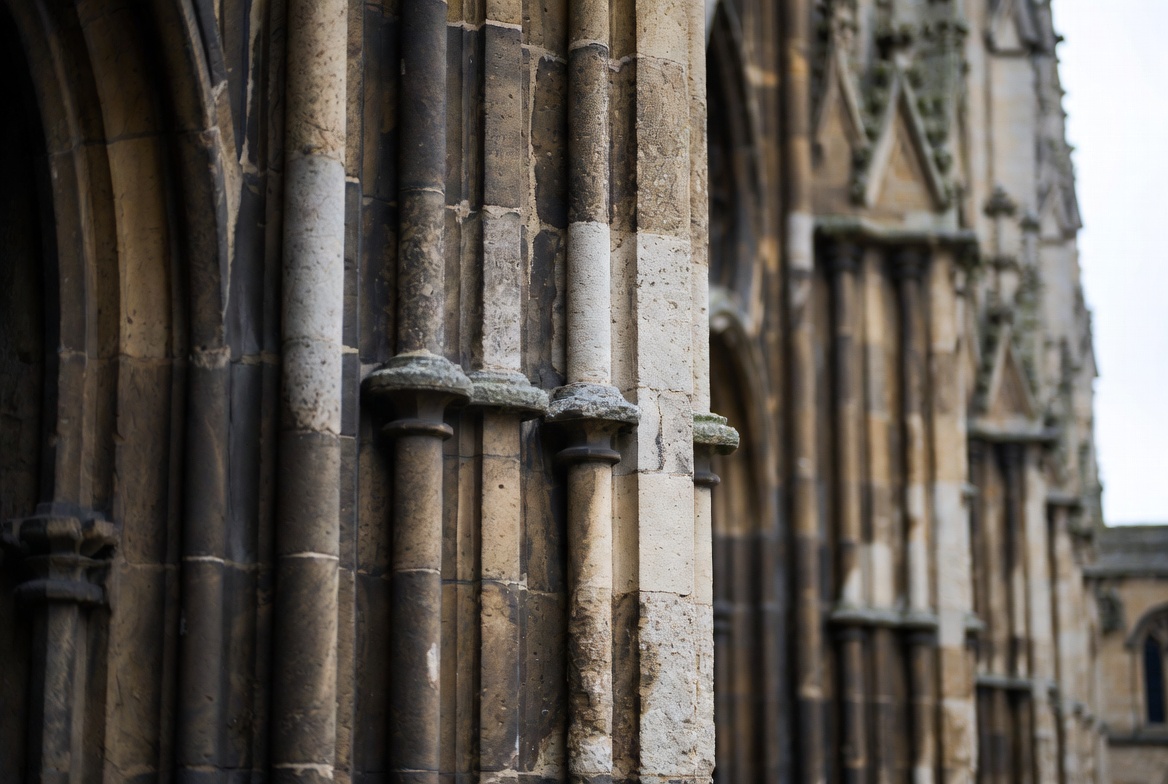
Norman / Romanesque (1066 – c. 1180)
Massive cylindrical piers, round-headed arches, small windows, simple geometric carving. Walls are thick because the round arch could not span far without help. Look for the chevron and dog-tooth ornaments around doorways.
See it at: St Bartholomew the Great, Temple Church (round nave), the Saxon arch at All Hallows.
Early English Gothic (c. 1180 – 1275)
The first English Gothic style. Pointed arches, narrow lancet windows, slim shafts often of dark Purbeck marble against pale stone. Vaults take to the sky for the first time.
See it at: the retro-choir at Southwark Cathedral, the chancel of Temple Church.
Decorated Gothic (c. 1275 – 1380)
Window tracery becomes elaborate; the geometric gives way to flowing curvilinear forms. Mouldings deepen, carving softens. Henry III's rebuilding of Westminster Abbey straddles this style.
See it at: Westminster Abbey nave, parts of Southwark Cathedral.
Perpendicular Gothic (c. 1380 – 1530)
The English late-Gothic style. Vertical mullions march up enormous windows; vaults sprout fan ribs; walls are pierced almost into transparency. Henry VII's Lady Chapel at Westminster Abbey is the most exuberant survival.
See it at: St Margaret's Westminster (the whole nave), Henry VII's chapel at the Abbey.
English Baroque (c. 1670 – 1730)
After the Great Fire of 1666 Christopher Wren and his successors gave the City a new architectural language: Portland-stone exteriors of restrained Roman classicism, with steeples that twist heavenward in tier upon tier of inventive ornament. Inside, plaster ceilings, tall round-headed windows, and elegant galleries.
See it at: St Paul's Cathedral, St Mary-le-Bow, St Stephen Walbrook, St Clement Danes, St Martin-in-the-Fields.
Neo-Byzantine (1890s – 1930s)
An imported style — basilican plans with shallow domes and striped brickwork modelled on Hagia Sophia and the churches of Ravenna. Mosaic, marble revetment and rounded arches signal this rare London look.
See it at: Westminster Cathedral.
Post-war reconstruction (1945 – 1960s)
Many City churches were gutted by bombs in 1940–41 and rebuilt either as faithful restorations (St Bride's), or as creative re-interpretations of Wren's interiors with mid-twentieth-century materials. Modern stained glass, simplified ceilings, and re-cast bells are the marks.
See it at: All Hallows by the Tower, St Mary-le-Bow, St Clement Danes.
Five things to look up
- Vaulting: stone ribs above the nave, fan vaults at their most ornate.
- Bosses: the carved knots where vault ribs cross.
- Misericords: hidden carvings under the choir-stall seats.
- Tomb canopies: medieval architecture in miniature.
- Stained glass: medieval (deep, jewelled), Victorian (narrative), modern (abstract or symbolic).